
How attic ventilation is supposed to work
A ventilated attic works like a chimney. Cooler outside air comes in low, through vents in the soffits under the eaves. It warms, rises and leaves high, through a ridge vent or roof vents. That steady flow carries summer heat away from the underside of the shingles and carries winter moisture out before it condenses on the cold roof deck. Northern Virginia's hot, humid summers and freezing winters make both jobs important.
What a ridge vent is
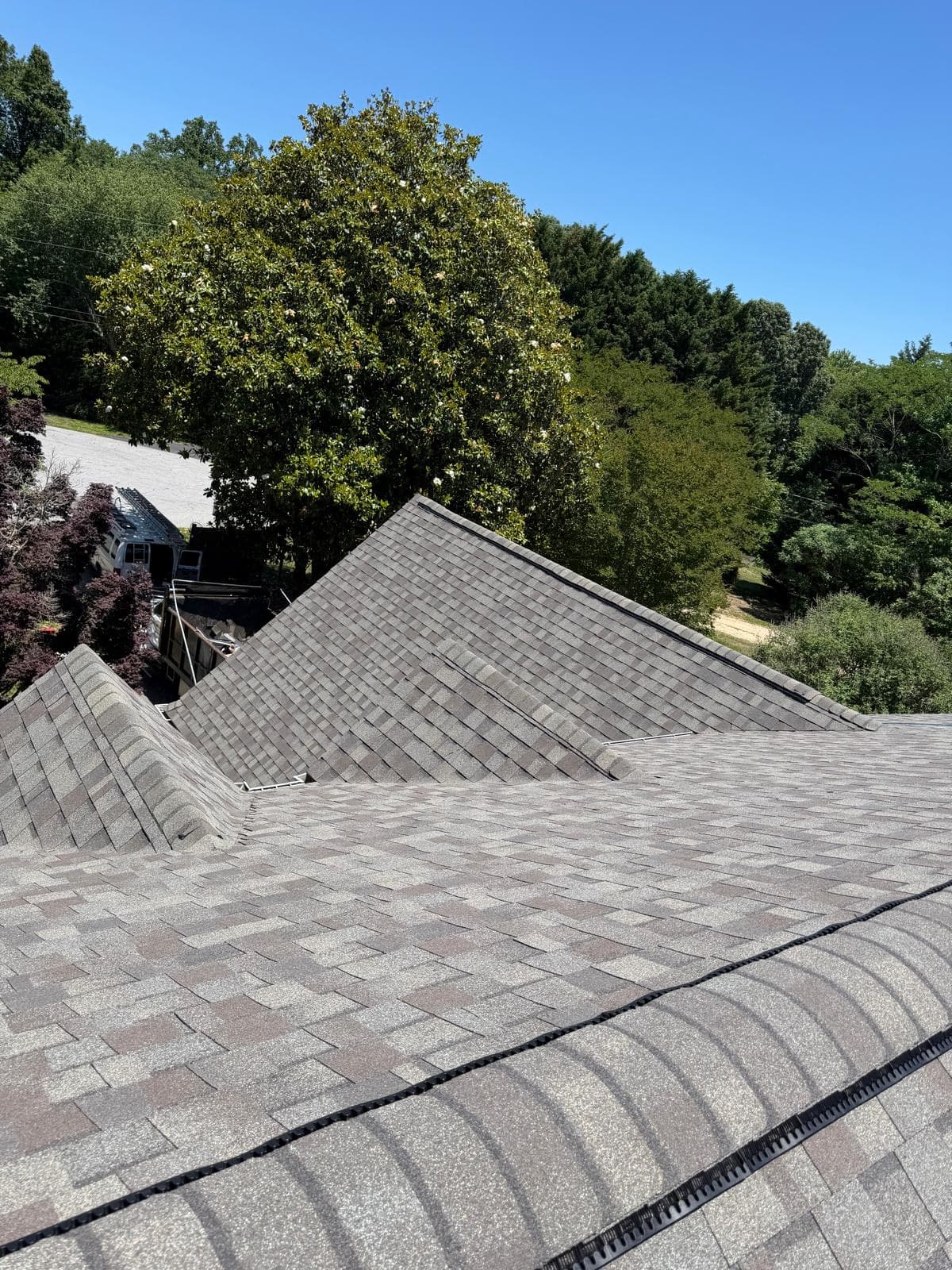
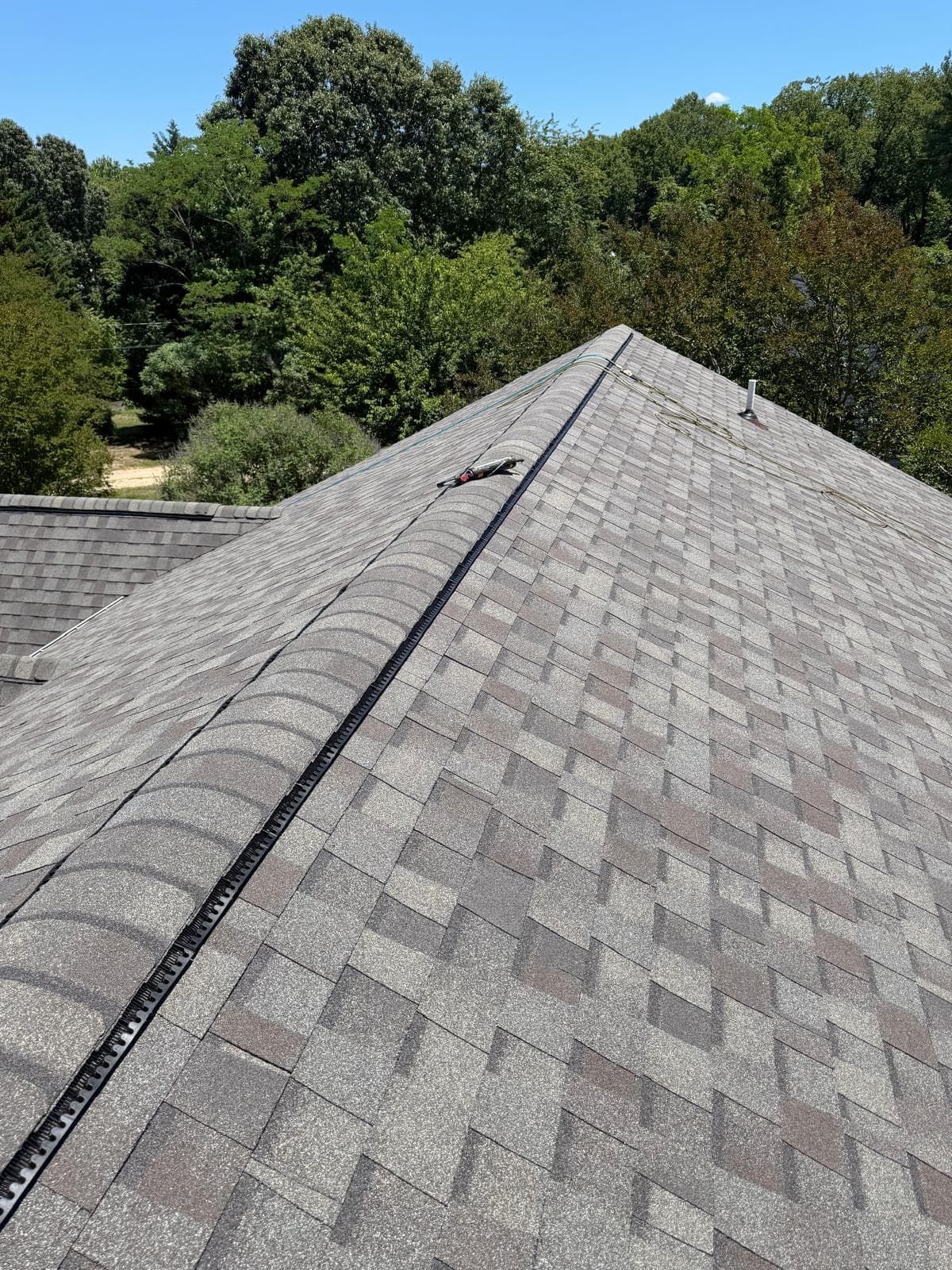
A ridge vent is a continuous vent along the peak of the roof. During installation the roofer cuts a slot in the decking on either side of the ridge, then covers it with a vent product and ridge cap shingles so it blends in. Because it runs the length of the ridge and sits at the highest point, it pulls air evenly from the whole attic. The photos on this page are from an Ashburn roof replacement in Loudoun County and show new ridge venting installed along the finished ridge.
Things that make a ridge vent work poorly
- Blocked soffits. Exhaust only works if air can get in at the bottom; insulation stuffed into the eaves or painted-over soffit vents starve it.
- Competing exhaust vents. Box vents or a powered attic fan near the ridge can pull air in through the ridge vent instead of through the soffits, short-circuiting the flow.
- A short ridge. Hip roofs and roofs with many small ridges may not have enough ridge length, and may need a different exhaust plan.
Where bathroom fans should go
A bathroom fan moves warm, very moist air. If that air is dumped into the attic, the moisture condenses on the cold underside of the roof deck in winter, soaks insulation, and can lead to mold, rot and stains that look exactly like a roof leak. The International Residential Code, which the Virginia Residential Code is based on, is explicit in Section M1501.1: air removed by mechanical exhaust systems must be discharged to the outdoors, and air shall not be exhausted into an attic, soffit, ridge vent or crawl space.
That last part surprises people. A bath fan duct that ends next to the ridge vent, or pointed at a soffit vent, is not venting outdoors in the code's sense: the moist air simply gets pulled back into the attic. The fan needs its own duct, connected to a dedicated roof cap or wall cap with a damper.
What we find in Sterling-area attics
- Flexible ducts that have come loose and lie on the insulation.
- Ducts run toward a soffit and left open.
- Ducts that sag and collect condensation, which drips back into the fan.
- Old roof caps with broken dampers or deteriorated flashing.
- Fans added in a later bathroom remodel with no duct at all.
Why a re-roof is the right time to fix it
When the old roof is off, every penetration is exposed. Adding or relocating a roof cap is a clean, flashed detail instead of a cut through finished shingles. The ridge is open, so a ridge vent can be added or extended. Old box vents can be removed and their holes decked over. And the roofer can see the deck around existing exhaust caps, where moisture damage tends to concentrate. If the scope does not mention exhaust caps and ventilation, ask why.
What you can check yourself
- From the attic hatch, with a flashlight and without stepping off the framing, look for ducts and where they end.
- Look for dark staining or frost on the underside of the deck in winter, especially near bathrooms.
- Outside, count the vents: is there a ridge vent, box vents, gable vents, or a mix?
- Look under the eaves: are there soffit vents, and are they clear?
Related pages
Can my bathroom fan vent into the ridge vent?▸
No. The model residential code Virginia builds on specifically says exhaust air shall not be exhausted into an attic, soffit, ridge vent or crawl space. It needs its own duct to an outdoor cap.
Do I need both soffit vents and a ridge vent?▸
A ridge vent depends on intake air. Without working soffit or other low intake, it cannot move much air through the attic.
Should I keep my box vents when a ridge vent is added?▸
Mixing exhaust types can short-circuit airflow. Whether to remove them depends on the roof, and it should be decided as part of the ventilation plan in the scope.
Why is there frost in my attic in winter?▸
Often moisture from inside the house, such as an unducted bath fan or air leaks around ceiling fixtures, condensing on the cold deck. It is worth investigating before it causes damage.